TaTalife Hybrid vs OUTEXER Traditional Cabin Sauna: Which Backyard Cabin Wins?
Last updated: Aug 24, 2026 · Category: Outdoor Cabin Sauna
We compare the TaTalife hybrid cabin and the OUTEXER traditional cabin on price, heating systems, capacity and build — and pick a winner for most buyers.
TaTalife Hybrid vs OUTEXER Traditional Cabin: Quick Answer
The TaTalife hybrid wins if you want two heat styles in one room — far-infrared panels plus a 6 kW electric stove with steam — and don't mind paying roughly $1,800 more; the OUTEXER wins on price, capacity, and simplicity for a single-heat-style household. Both are outdoor wooden backyard cabins, but they represent two different answers to the same question: how should a home sauna make heat?
Choose the TaTalife hybrid when household members disagree about what a sauna should feel like, or when red-light therapy features matter. Choose the OUTEXER traditional cabin when you know exactly which single experience you want, want room for up to five, and would rather not pay for a second heating system you may rarely use.
Affiliate disclosure: As an Amazon Associate, we earn from qualifying purchases. This article contains affiliate links. If you buy through these links, we may earn a commission at no extra cost to you. We do not test saunas hands-on; comparisons are based on manufacturer-published specifications and listing data current as of August 2026.
Side-by-Side Comparison
| TaTalife Hybrid Cabin | OUTEXER Traditional Cabin | |
|---|---|---|
| Price band (researched Aug 2026) | $5,799.99 | $3,999.00 |
| Heating systems | Dual system: far infrared plus electric stove/steam (as listed) | Single system (listing titles steam; research records carbon infrared — see below) |
| Rated power | 6 kW | 4.5 kW |
| Voltage | 220 V | 240 V |
| Capacity | 3–4 people | 4–5 people |
| Wood | Canadian red cedar | Spruce |
| Max temperature | 149°F (recorded) | Not published in our research data |
| Special features | Red light therapy feature recorded | LED lighting included |
| Footprint | Not published in our research data | 6 ft x 6 ft (per listing) |
| Warranty | Not published in our research data — confirm on the listing | Not published in our research data — confirm on the listing |
Prices change often — check the current Amazon listing before you buy.
Check TaTalife hybrid sauna price on Amazon
Check OUTEXER traditional cabin sauna price on Amazon
Why This Comparison Matters
Backyard sauna shopping usually forces a choice made once and lived with daily: the heating style defines every session you will ever have in the room. Far-infrared heating warms the body directly with panels at lower air temperatures; stove-and-steam heating warms the air itself and supports the water-on-stones ritual; the two experiences feel so different that many households genuinely cannot agree on which one they want.
That disagreement is exactly where hybrid cabins earn their premium. The TaTalife packages a far-infrared system alongside a 6 kW electric stove in one cedar room, letting users pick per session. The single-system cabin represented by the OUTEXER bets on one mechanism done simply, at a lower price and higher stated capacity.
The comparison also matters because listings in this category are not always self-explanatory. The OUTEXER's title says "Traditional Steam Saunas," while our research records carbon infrared heating — a real discrepancy buyers should resolve with the seller before purchase. We flag it openly here because it changes what the product actually is.
TaTalife Hybrid Cabin: Two Heat Styles, One Cedar Room
The TaTalife is an all-weather backyard spa cabin in Canadian red cedar, stated for 3 to 4 people, combining a far-infrared system with a 6 kW electric sauna stove — the listing describes it as a dual-system far infrared and steam room on a 220-volt supply. Our research records a maximum temperature of 149°F and a red light therapy feature among its specifications.
The practical value of the dual system is flexibility. A far-infrared session runs at lower air temperatures with direct radiant warmth, which many people prefer for longer, gentler sessions; a stove-heated session pushes air temperature higher and supports the classic hot-sauna feel. Owning both in one room means the household never has to settle the argument permanently — and guests can choose their own comfort zone.
Red cedar is the other headline spec. It is the wood most traditional sauna builders specify: stable through humidity swings, comfortable to touch at high temperatures, and carrying the aroma most people associate with a "real" sauna. For an outdoor structure living through seasons, that material choice supports long-term durability.
The honest gaps: exterior dimensions are not published in our research data, so verify the footprint fits your pad before ordering; warranty terms are likewise unpublished; and at $5,799.99 at research time this is the more expensive build by a wide margin. The 6 kW draw on a 220-volt supply also means professional wiring is effectively mandatory.
See the TaTalife Hybrid Sauna Cabin on Amazon
OUTEXER Traditional Cabin: More Room, Less Money
The OUTEXER is a 6-by-6-foot outdoor cabin stated for 4 to 5 people, drawing 4.5 kW on a 240-volt supply, lined with spruce, and including LED lighting according to the listing. At $3,999.00 at research time it undercuts the TaTalife by $1,800.99 while claiming the larger capacity — objectively more room per dollar.
The specification story needs honesty up front. The listing title markets a "Traditional Steam" sauna, but our research data records carbon infrared heating as the mechanism. Those are different products in practice: a steam-heated room delivers hot humid air, while carbon infrared panels deliver lower-air-temperature radiant heat. Neither interpretation is bad — but they are not interchangeable, and we recommend buyers confirm the exact heater configuration with the seller before ordering. What is unambiguous is the electrical picture: 4.5 kW at 240 volts still requires a dedicated circuit and professional installation.
Spruce versus the TaTalife's red cedar is the core of the value engineering. Spruce is a legitimate sauna wood used across the industry; it lacks some of cedar's aroma and dimensional stability but costs meaningfully less, and that saving flows straight into the price. The included LED lighting supports evening sessions, and the published 6-by-6-foot footprint makes pad planning straightforward — one of the few dimension figures published anywhere in this pairing.
For households that already know which single heat style they want, paying for a second system they will not use is waste. The OUTEXER exists precisely for that buyer.
See the OUTEXER Traditional Cabin Sauna on Amazon
Head-to-Head: Where They Differ
Price and Value
The OUTEXER costs $3,999.00 against the TaTalife's $5,799.99 — an $1,800.99 gap at research time. Per stated seat, the OUTEXER lands around $800–$1,000 per person across its 4–5 range versus roughly $1,450–$1,933 per person for the TaTalife's 3–4 seats. The TaTalife justifies its premium only through the second heating system, the red-light feature, and cedar construction. If any of those three matter to your household, the math can work; if none do, the OUTEXER is the better-value structure by a clear margin.
Heat Experience
This is the philosophical split. The TaTalife offers both major modalities: far-infrared radiant sessions at recorded maximums of 149°F, and stove-driven hot-air sessions via its 6 kW unit. The OUTEXER commits to one mechanism — recorded as carbon infrared, titled as traditional steam — and the discrepancy must be resolved before purchase because the two experiences differ fundamentally. Households with mixed preferences or first-time buyers still discovering their taste should weight the TaTalife's flexibility heavily; committed single-style users lose nothing with the OUTEXER.
Capacity and Space
Stated capacity favors the OUTEXER: 4–5 people against 3–4, inside a published 6-by-6-foot plan. That square layout gives flat walls for multi-bench seating and standing headroom, while the TaTalife's interior arrangement is not dimensioned in our research data. For regular group sessions, the OUTEXER's numbers win; note that a fuller room heats differently depending on the mechanism, another reason to confirm exactly what heater the OUTEXER ships with.
Wood and Durability
Canadian red cedar (TaTalife) versus spruce (OUTEXER). Cedar generally earns higher marks for aroma, stability through humidity swings, and outdoor longevity — meaningful for a structure that lives in your yard year-round. Spruce performs well with basic care and keeps the price down. Both are standard sauna woods; whichever you choose, follow the manufacturer's roofing, foundation, and finishing guidance, since outdoor lifespan depends more on siting and maintenance than species alone. Neither listing publishes warranty terms in our research data — confirm before purchase.
Installation and Electrical
Both cabins require professional wiring: the TaTalife draws 6 kW at 220 volts, the OUTEXER 4.5 kW at 240 volts. North American households supply 240-volt split-phase power, so confirm with the seller and your electrician that the TaTalife's 220-volt rating is approved for 240-volt operation before ordering. Assembly is kit-based for both; neither publishes assembly-time estimates in our research data. The OUTEXER's published 6-by-6 footprint simplifies site prep; get equivalent figures for the TaTalife from the seller.
Running Cost and Daily Use
Lower rated power usually means lower energy draw per hour: the OUTEXER's 4.5 kW against the TaTalife's 6 kW. But usage pattern complicates the picture — far-infrared sessions often run longer at lower temperatures, while stove sessions run hotter and shorter, so real-world bills depend on which mode a hybrid owner actually uses. Neither manufacturer publishes energy consumption figures in our research data. Treat the ratings as relative scale, not monthly cost predictions, and factor your local electricity rate.
Which Should You Buy?
Buy the TaTalife hybrid if: your household wants both infrared and stove-style heat available session by session, values red cedar and the recorded red-light feature, and accepts the higher price and 6 kW electrical load as the cost of that flexibility.
Buy the OUTEXER traditional cabin if: you want the most capacity and floor space per dollar, prefer a simpler single-system build, need a known 6-by-6 footprint for site planning, and will confirm the exact heater configuration with the seller before purchase.
Verdict: TaTalife Hybrid vs OUTEXER Traditional Cabin
For most budgets the OUTEXER is the rational default: $1,800.99 less at research time, a larger stated capacity, a published footprint, and enough unspecified simplicity that — once the heater configuration is confirmed — it delivers a complete backyard sauna experience without paying for redundancy. The TaTalife earns its premium in specific households: mixed heat-style preferences, red-light interest, and cedar preference together justify the dual-system price. Buy the hybrid to end the household debate; buy the traditional cabin if the debate is already settled.
Check the OUTEXER Traditional Cabin price on Amazon
Check the TaTalife Hybrid Cabin price on Amazon
Frequently Asked Questions
Is a hybrid sauna worth the extra money?
Only if your household will actually use both modes. The TaTalife costs $1,800.99 more than the OUTEXER at research time, and that premium buys heating flexibility — far-infrared sessions and stove-style heat in one room — plus cedar construction and a recorded red-light feature. Single-preference households are better served by a cheaper single-system cabin.
Why does the OUTEXER's title say steam but the research says infrared?
That is a genuine listing-versus-data discrepancy we chose to surface rather than hide. Our research records carbon infrared heating for the OUTEXER, while its listing title references traditional steam. Because the two mechanisms produce very different sessions, ask the seller exactly which heater ships with the cabin before buying.
Do these cabins need a special electrical setup?
Yes, both. The TaTalife draws 6 kW at 220 volts and the OUTEXER 4.5 kW at 240 volts — dedicated-circuit loads beyond ordinary outlets. Plan on licensed electrician installation, and confirm voltage compatibility for the 220-volt-rated TaTalife on North American 240-volt supply before ordering.
Which wood lasts longer outdoors: cedar or spruce?
Cedar generally resists moisture cycling and decay better and carries the classic sauna aroma, which is why it dominates premium builds like the TaTalife. Spruce is a cost-effective industry standard that performs well with proper sealing and siting. Either structure's lifespan depends more on foundation, roof coverage, and upkeep than on species alone.
How much does each cost to run?
No official energy consumption figures are published in our research data for either product. The OUTEXER draws less power per hour (4.5 kW vs 6 kW), but the TaTalife's infrared mode typically runs at lower air temperatures, and session lengths differ by style. Compare your local electricity rate against realistic session patterns rather than relying on the ratings alone.
Can I put either cabin straight on grass?
No. Both need a firm, level, well-drained base — concrete pavers or a level gravel bed are the usual answers — and neither manufacturer publishes foundation specifications in our research data beyond the OUTEXER's 6-by-6-foot plan. Prepare the pad before delivery and confirm site requirements with each seller.
More in Outdoor Cabin Sauna
Products in this research
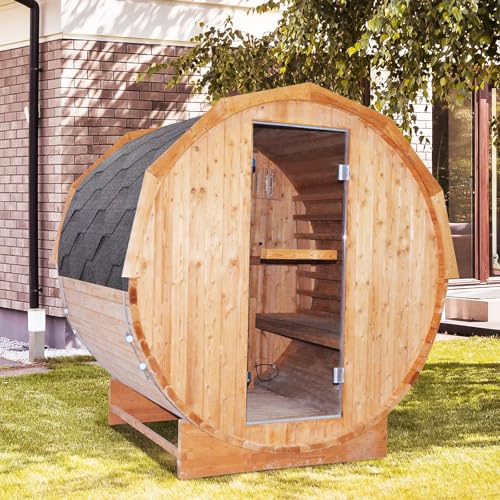 OUTEXER Traditional Sauna 4-5 Person 240V 4.5KW 6'x6’ Steam Saunas
 TaTalife Hybrid Sauna, 3-4 Person Dual System Far Infrared & Steam Sauna Room, Canadian Red Cedar Wo
Research methodology
This article was generated from verified product data using our research pipeline. Products are scored against 9 weighted criteria. Claims are cross-referenced against manufacturer specifications and Amazon API data.